
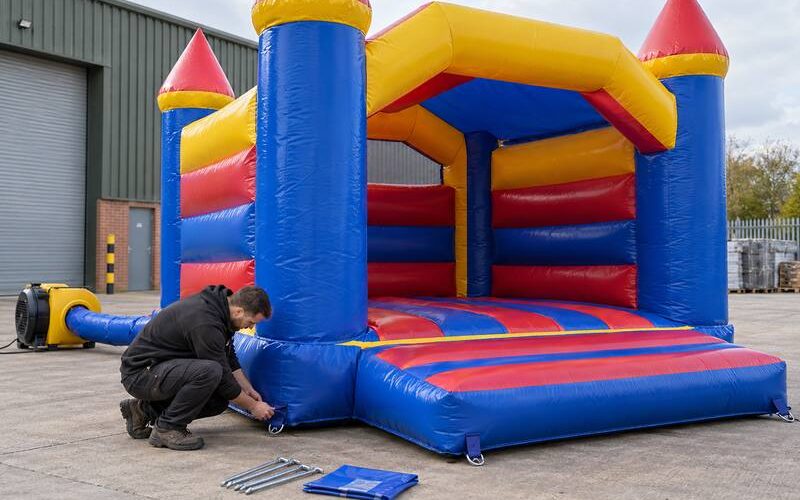
Buying a commercial bouncy castle is different from choosing an inflatable for occasional private use. A hire business needs equipment that can withstand regular transport, setup, cleaning and repeated use throughout the season.
Colour and theme may attract customers, but they should not be the only reasons for choosing a product. Construction, dimensions, anchoring, airflow and documentation can have a much greater effect on daily operation and long-term value.
Choosing carefully can reduce repairs, shorten setup times and help you avoid buying equipment that is unsuitable for your vehicle, storage space or typical venues.
Before adding a new inflatable to your hire fleet, consider these seven important features.
1. Commercial-Grade Material and Construction
The material is one of the first details to check when comparing commercial bouncy castles.
Equipment intended for regular hire should be made from material suitable for repeated inflation, packing, transport and cleaning. Commercial PVC is commonly used because it is durable, relatively easy to clean and suitable for frequent operation.
Ask the manufacturer to confirm:
- The type of material used
- The material weight and thickness
- Whether different sections use different specifications
- How high-wear areas are reinforced
- Whether matching repair material is included
Do not judge quality by thickness alone. The strength of the finished inflatable also depends on the fabric base, coating, internal construction, stitching and reinforcement.
A heavier inflatable is not automatically better. However, very lightweight equipment may not be suitable for the repeated handling expected in a commercial hire business.
The right material and construction can reduce premature wear and help the inflatable remain presentable after regular use.
2. Reinforced Seams and High-Wear Areas
A commercial bouncy castle experiences repeated pressure and movement. Users bounce on the bed, climb through entrances and place additional stress on steps, slides and internal connections.
For this reason, the way the inflatable is stitched and reinforced matters as much as the outer material.
Important areas to inspect include:
- The entrance step
- The bouncing bed
- Internal baffles
- Slide connections
- Climbing sections
- Corners and turns
- Blower tubes
- Anchor-point connections
High-stress areas may require additional layers of material or multiple rows of stitching. Reinforcement should support the structure without creating exposed hard edges or unnecessary trip points.
Before ordering, ask for close-up photographs of the stitching, internal connections, anchor points and inflation tubes. These details are often more useful than a front-view product image alone.
Good construction may not be immediately visible to the customer, but it can affect how well the inflatable performs after repeated hires.
3. A Practical Layout with Good Operator Visibility
An attractive design must also be practical to supervise.
For a standard children’s bouncy castle, the entrance should allow the operator or responsible supervisor to see the main play area clearly. Decorative features should not unnecessarily block the view of users.
For combination units and more complex inflatables, consider whether the layout allows users to move through the equipment without creating confusing crossing points.
Look at:
- Visibility into the bouncing area
- Entrance and exit positions
- The route to the slide
- The position of climbing sections
- Separation between different activities
- The height and design of containing walls
- Areas hidden behind decorative elements
A highly detailed theme may look impressive in photographs, but oversized characters and decorative structures can make cleaning, packing and supervision more difficult.
A practical design should balance visual appeal with clear sightlines, straightforward movement and efficient daily operation.
4. Suitable Anchor Points and Setup Options
Anchoring is an essential part of inflatable setup. Before buying, check the number, position and construction of the anchor points.
Anchor points should be properly reinforced and positioned at the base of the inflatable so that securing forces are transferred through the intended parts of the structure. They should not appear to have been added as an afterthought.
Ask the manufacturer for:
- A diagram showing every anchor point
- Close-up photographs of the attachment method
- Information about suitable ground stakes
- Guidance for setup on different surfaces
- Instructions for safe installation and operation
If you expect to accept bookings at indoor venues or on hard standing, establish how the inflatable can be secured before purchasing it. A design that works well on grass may require a different anchoring arrangement on another surface.
The hire operator must assess each site and follow the relevant operating instructions. Clear anchoring information makes planning easier and reduces the risk of discovering a setup problem after arriving at the venue.
5. The Correct Blower and Airflow
A commercial inflatable must be matched with an appropriate blower.
A blower that provides insufficient airflow may leave the structure soft or unstable. An unsuitable blower can also create operating problems and affect the performance of the inflatable.
Before ordering, confirm:
- The required blower output
- The number of blowers needed
- The voltage and frequency
- The plug type
- The position and length of the inflation tubes
- Whether the blower is included
- Whether a spare blower should be kept
For equipment intended for the UK, the electrical specification should be suitable for local use. If the blower is supplied from overseas, do not assume that its plug, voltage and electrical specification will automatically meet your requirements.
The position of the blower tube also matters. It should allow the blower to be placed securely without obstructing the entrance, customer access or normal supervision.
For larger inflatables, ask whether more than one blower is required and whether separate electrical supplies may be needed. This information can affect which venues are suitable for the product.
6. Dimensions That Suit Your Customers and Transport
A large inflatable may attract attention, but it is only useful if you can transport, store and install it efficiently.
Always request the complete inflated dimensions, including:
- Length
- Width
- Height
- Entrance or step projection
- Blower-tube position
- Required operating area
The space needed at a venue will normally be larger than the dimensions of the inflatable itself. Additional room may be required for anchoring, blowers, mats and safe access.
Height is particularly important for indoor bookings. Community halls and sports centres may have lighting, beams or ceiling fixtures that reduce the usable clearance.
You should also confirm:
- Packed dimensions
- Packed weight
- Number of storage bags
- Recommended number of handlers
- Suitable vehicle size
An inflatable may fit in a customer’s garden but still be unsuitable for your business if it is too heavy for your staff or too large for your vehicle.
Consider the full journey from storage to installation. A product that can be transported and set up efficiently may generate a better return than a larger unit requiring extra staff for every booking.
7. Documentation and After-Sales Support
Good documentation helps an operator understand how the inflatable should be installed, used, maintained and inspected.
Before confirming an order, ask what information will be supplied. Depending on the product and its intended use, this may include:
- Operating instructions
- Product dimensions
- Blower requirements
- Anchoring information
- User limitations
- Maintenance guidance
- Product identification details
- Inspection or test documentation
- A list of included accessories
Commercial hire equipment in the UK should be selected with the relevant safety and inspection requirements in mind. If you are unsure whether a particular design falls within the scope of an inspection scheme, consult a competent UK inspector before ordering.
Do not wait until the inflatable arrives before discussing documentation. Ask the manufacturer what can be supplied and whether additional information will be available for your business records or inspection.
This is also a good time to compare after-sales support. East Inflatables, for example, can confirm the material specification, dimensions, blower requirements, included accessories and available documentation before production begins.
Clear information before purchase is more valuable than a general promise that details will be provided later.
Look Beyond the Main Product Photograph
Product photographs are useful, but they do not show everything a hire business needs to know.
Before making a final decision, request enough information to understand:
- How the inflatable is constructed
- How it will be anchored
- Which blower it requires
- How much it weighs when packed
- Whether it fits your vehicle and storage
- What documents are supplied
- What support is available after delivery
If an important detail is unclear, ask before placing the order. Correcting a misunderstanding before production or shipment is usually easier and less expensive than dealing with unsuitable equipment after delivery.
A careful buying process can also help you compare manufacturers on more than appearance and price.
Final Thoughts
The best commercial bouncy castle for a UK hire business is not necessarily the biggest, cheapest or most colourful option.
A suitable product should combine durable construction, practical dimensions, clear visibility, reliable airflow and properly positioned anchor points. It should also be manageable for your staff and supported by useful operating information.
By checking these seven features before buying, you can choose equipment that fits your customers, transport and daily working routine. This can reduce avoidable repairs, make setups more efficient and help each inflatable deliver better long-term value for your hire business.