
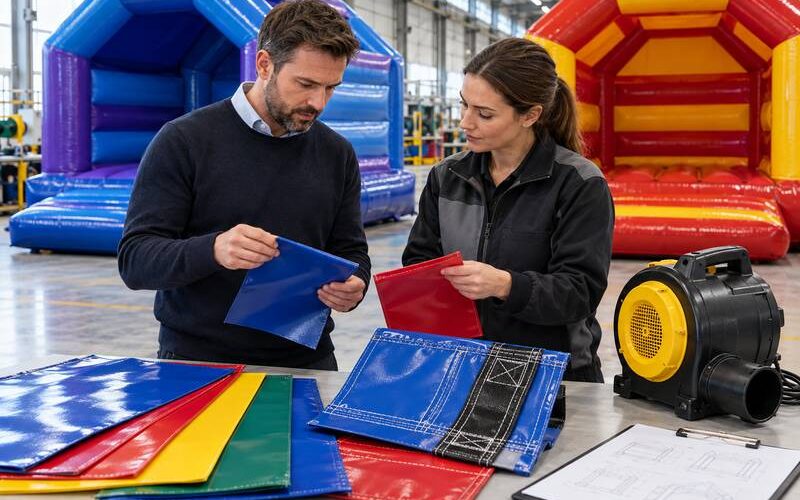
Buying a commercial bouncy castle is very different from choosing an inflatable for occasional home use. Commercial equipment may be hired every weekend, transported repeatedly and used by many children throughout the season.
The manufacturer you choose can therefore affect much more than the initial purchase price. Materials, construction, documentation, communication and after-sales support can all influence how safely and profitably the inflatable performs.
Before placing an order, compare manufacturers using the same practical criteria. This will help you identify genuine value and avoid making a decision based on price or appearance alone.
Confirm That It Is Designed for Commercial Use
Some inflatables may look impressive in photographs but are not designed for regular commercial hire.
Ask the manufacturer to confirm that the product is suitable for repeated commercial use. It should be built to withstand frequent inflation, deflation, transport, cleaning and storage.
Request clear information about:
- The type and thickness of the material
- Reinforcement in high-wear areas
- Stitching methods
- Internal construction
- Anchor point design
- Inflation and deflation systems
- The intended operating environment
Avoid relying only on descriptions such as “heavy duty” or “professional quality”. These phrases are difficult to compare unless the manufacturer provides actual specifications.
Compare the PVC Material
The material is one of the most important parts of a commercial inflatable.
Ask each manufacturer for the PVC thickness or weight and confirm whether the same material is used throughout the inflatable. Some products may use heavier material in visible areas and lighter material elsewhere.
When comparing materials, consider:
- PVC thickness and weight
- Tear resistance
- Surface coating
- Flexibility
- Flame-retardant information
- Colour and print durability
- Ease of cleaning and repair
A heavier material is not automatically better in every situation. The quality of the base fabric, coating, stitching and reinforcement also matters.
The manufacturer should be able to explain why the chosen material is suitable for the product rather than simply quoting a thickness.
Examine Stitching and Reinforcement
Strong PVC can still fail early if the stitching and reinforcement are poor.
Ask for close-up photographs or videos of:
- Main seams
- Entrance steps
- Bouncing beds
- Slide platforms
- Climbing sections
- Inflation tubes
- Anchor points
- Corners and other stress areas
High-contact areas should have suitable reinforcement. Stitching should appear consistent and secure, without loose threads, irregular spacing or poorly aligned panels.
It is also useful to ask how the manufacturer reinforces internal stress points. These areas may not be visible after production, but they help the inflatable maintain its intended shape during use.
Check the Anchor Point Design
Anchor points are a safety-critical part of a commercial bouncy castle.
Ask the manufacturer to show where the anchor points are positioned and how they are reinforced. Ground-level anchor points should be securely connected to the lowest structural edge of the inflatable rather than attached casually to an unsupported side panel.
Confirm:
- The number of anchor points
- Their positions
- The reinforcement method
- The recommended anchoring equipment
- Whether anchoring instructions are supplied
- Whether different surfaces require different equipment
A manufacturer should be willing to discuss the anchoring arrangement before production, particularly when the design is being customised.
Confirm the Blower Specification
The blower must be suitable for both the inflatable and the destination country.
For the UK market, confirm that the blower is supplied for the correct voltage and frequency and has a suitable UK plug. Do not assume that every manufacturer will automatically provide the correct electrical configuration.
Ask for:
- Blower power
- Voltage and frequency
- Plug type
- Airflow or pressure information where available
- Available electrical certification information
- The recommended number of blowers
- Blower warranty details
The blower should match the manufacturer’s specification for the inflatable. An incorrectly sized blower may cause poor inflation or place unnecessary pressure on the structure.
If the product needs more than one blower, confirm whether all of them are included in the quotation.
Compare the Actual Dimensions
Photographs can make an inflatable appear larger or smaller than it really is.
Compare products using their external length, width and height. Check whether the quoted dimensions include entrance steps, inflation tubes or decorative features.
You should also ask for:
- The required operating area
- Recommended clearance around the inflatable
- Packed dimensions
- Packed weight
- Number of storage bags
- Staff required for handling
- Suggested vehicle size
A product may fit the customer’s venue but still be difficult to transport or store. Packed size and weight are particularly important for new hire businesses with limited vehicle or warehouse space.
Accurate dimensions also make quotations easier to compare. Two products with similar photographs may use very different amounts of material.
Ask What Is Included in the Quotation
A low quotation may not include everything needed to operate the inflatable.
Ask each manufacturer to provide a clear list of included accessories. Depending on the product, these may include:
- Blower or blowers
- Storage bag
- Repair materials
- Ground stakes
- Ropes or straps
- Operating instructions
- Product identification label
- Available manufacturing or inspection documents
Also confirm whether custom artwork, logo printing, packaging and delivery are included.
A lower product price may become less competitive once missing accessories and transport charges are added.
Review the Available Documents
Commercial buyers should ask what product information and documents are available before confirming an order.
The exact requirements may vary depending on the inflatable type, destination, insurer, inspector and intended use. One general certificate may not cover every product or every local requirement.
Useful information may include:
- Product specifications
- Material information
- Blower details
- Operating instructions
- Daily inspection guidance
- Anchoring information
- Maintenance recommendations
- Identification labels
- Available test reports or declarations
If a particular document is required by your insurer, inspector, local authority or venue, confirm the exact requirement before ordering.
Send the requirement to the manufacturer in writing and ask whether it can be supplied for the selected model. Do not assume that a general statement of compliance will automatically be accepted.
Assess the Manufacturer’s Communication
Communication before an order often indicates what support may be like afterwards.
A reliable manufacturer should answer technical questions clearly and distinguish confirmed information from estimates. They should also clarify the materials, dimensions, accessories, artwork and delivery terms before requesting payment.
Pay attention to whether the manufacturer:
- Answers the questions you asked
- Provides consistent product information
- Explains what is included
- Confirms important changes in writing
- Supplies updated drawings for customised products
- Identifies production limitations
- Gives realistic production and shipping estimates
Good communication is particularly important when purchasing directly from an overseas factory because specifications, documents and shipping arrangements must all be confirmed remotely.
Review the Customisation Process
Custom colours, artwork and logos can help a hire business stand out, but customisation should not compromise the structure or safe operation of the inflatable.
If you need a customised product, ask:
- Which standard PVC colours are available
- Which areas require digital printing
- How artwork will be positioned
- Whether logos can be added
- Whether structural changes are possible
- Whether a design drawing will be supplied
- Whether customisation affects price or production time
Review all artwork, text, dimensions and colours carefully before approving the design.
Request an updated drawing whenever an important change is made. Verbal confirmation alone can lead to misunderstandings during production.
Ask About Production Checks
A manufacturer should be able to explain the main production stages, including cutting, printing, stitching, assembly and final inspection.
Ask whether the completed inflatable will be fully inflated and checked before packing. It is also reasonable to request photographs or a video of the finished product before shipment.
Use the final images or video to check:
- Overall shape
- Colours and artwork
- Entrance position
- Included accessories
- Inflation performance
- Visible workmanship
- Custom details
A production video does not replace an independent safety inspection, but it can help identify obvious errors before the inflatable leaves the factory.
Compare Warranty and After-Sales Support
A warranty is useful only when its terms are clear.
Ask what the warranty covers, how long it lasts and what evidence is required when making a claim. Find out whether the manufacturer can provide repair guidance, matching PVC or replacement components when needed.
Important questions include:
- What is covered by the inflatable warranty?
- Is the blower covered separately?
- Are shipping costs included in a claim?
- How are minor repairs handled?
- Can matching material be supplied?
- Are replacement components available?
- Who should be contacted after delivery?
Damage caused by incorrect operation, unsuitable storage or normal wear may not be covered. Read the warranty conditions rather than relying on a short statement in the quotation.
Compare Manufacturers Using the Same Specification
It is difficult to compare quotations when each one is based on a different product specification.
Create a simple checklist and send the same requirements to every manufacturer. Include:
- Product type
- External dimensions
- Intended users
- Commercial-use requirement
- Material specification
- Colour or theme
- Blower requirements
- Required accessories
- Documentation needs
- Delivery destination
Some manufacturers, including East Inflatables, provide material details, product dimensions, blower requirements and a clear list of included accessories before an order is confirmed. Information like this makes it easier to compare the actual equipment rather than the headline price alone.
If one quotation includes heavier construction, additional reinforcement or more accessories, a higher price may reflect a genuine difference in specification.
Understand the Delivery Terms
The product price is only one part of the total purchase cost.
Ask whether the delivery quotation covers:
- Factory collection
- Port delivery
- Port-to-port shipping
- Door-to-door delivery
- Import charges
- Customs clearance
- Local handling fees
Confirm the destination postcode and whether delivery is to a commercial address, warehouse or residential property.
You should also request:
- Estimated production time
- Estimated shipping time
- Packaging details
- Number of packages
- Total packed weight
- Customs documentation
- Responsibility for import clearance
- Possible local charges
Shipping prices can change, so check how long the quotation remains valid.
Compare Total Value, Not Just Price
The cheapest commercial bouncy castle is not always the least expensive to own.
A lower-priced product may cost more over time if it requires frequent repairs, arrives without essential accessories or needs to be replaced early.
Consider the complete value of the order, including:
- Construction quality
- Expected working life
- Included equipment
- Repairability
- Documentation
- Transport costs
- Warranty
- Communication
- After-sales support
- Potential hire income
A commercial inflatable is a working asset. The better choice is usually the one that provides reliable performance and a reasonable cost per hire, not simply the lowest initial quotation.
Warning Signs to Watch For
Take extra care if a manufacturer:
- Refuses to provide material specifications
- Uses only heavily edited product images
- Cannot show close-up construction details
- Gives inconsistent dimensions
- Avoids questions about anchoring
- Cannot confirm the blower specification
- Promises every certificate without checking the model
- Provides an incomplete quotation
- Changes payment details unexpectedly
- Pressures you to pay before specifications are confirmed
A single issue may be a misunderstanding. Several warning signs together should make you reconsider the order.
Frequently Asked Questions
Is It Better to Buy Directly from a Bouncy Castle Manufacturer?
Buying directly from a manufacturer may provide more options for custom colours, artwork, dimensions and accessories. However, buyers should also compare communication, documentation, warranty support, shipping arrangements and the total delivered cost.
What Information Should I Request Before Ordering?
Ask for the product dimensions, material specification, blower requirements, packed weight, included accessories, production time, warranty terms and available product documents. Important requirements should be confirmed in writing before payment.
Does a Higher Price Mean Better Quality?
Not necessarily. A higher price may reflect stronger materials, additional reinforcement, more accessories or better support, but this should be confirmed through actual specifications. Compare like-for-like products rather than relying on price alone.
What Blower Do I Need for a Commercial Bouncy Castle in the UK?
The blower should match the manufacturer’s specification for the inflatable and be suitable for the UK voltage, frequency and plug type. Confirm whether the correct blower is included before placing the order.
Final Thoughts
Comparing commercial bouncy castle manufacturers requires more than looking at photographs and prices.
Check the material, stitching, reinforcement, anchor points, blower, documents, accessories, warranty and delivery terms. Ask the same questions of every manufacturer and keep important specifications in writing.
A careful comparison takes more time at the beginning, but it can prevent expensive mistakes and help you choose equipment suitable for repeated commercial hire.
The right manufacturer should make it easier to understand exactly what you are buying before the order is confirmed.