
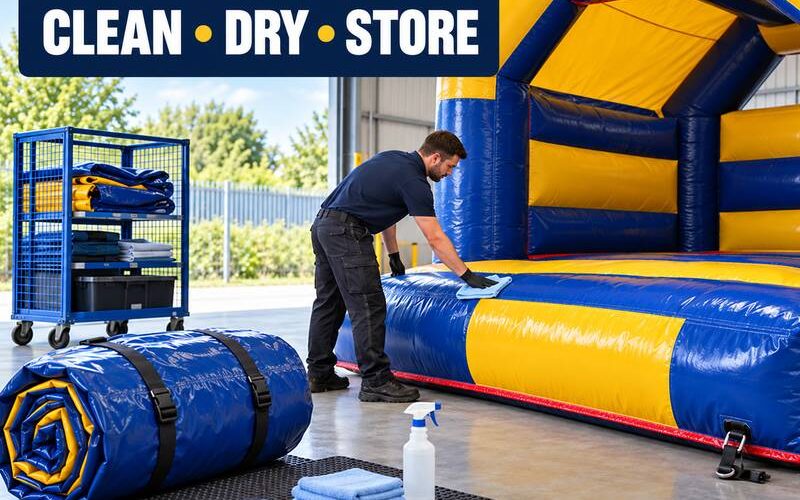
Regular cleaning and correct storage are essential parts of operating a commercial bouncy castle hire business.
A unit may look clean when it is collected, but grass, mud, food, moisture and small pieces of debris can remain inside or underneath it. If these are not removed before the inflatable is rolled and stored, they may cause stains, unpleasant odours, mould or premature wear.
A consistent between-hire routine also gives staff an opportunity to identify damage before the next booking.
This guide explains how to clean, dry, inspect, fold and store a commercial PVC bouncy castle safely and efficiently.
Why Clean a Bouncy Castle After Every Hire?
Commercial bouncy castles are used by different groups of children and may be installed on grass, indoor floors or other suitable surfaces.
During a typical hire, the inflatable may collect:
- Grass and mud
- Dust and leaves
- Food crumbs
- Drink spills
- Face paint
- Confetti
- Small toys
- Moisture
- Shoe marks
Removing these materials promptly is normally easier than dealing with dried stains later.
A clean inflatable also creates a better impression when it arrives at the next venue. Customers may judge the quality and professionalism of a hire company by the appearance and condition of its equipment.
Cleaning should therefore be part of the normal turnaround process rather than something completed only when the inflatable looks dirty.
Check the Manufacturer’s Instructions
Before using any cleaning product, read the operating and maintenance instructions supplied with the inflatable.
Commercial inflatables are commonly made from PVC-coated material, but printed artwork, transparent panels, mesh, hook-and-loop fasteners and other components may require different care.
The manufacturer’s instructions should take priority over general cleaning advice.
If you are unsure whether a product is suitable, test it on a small, inconspicuous area first. An unsuitable cleaner may fade colours, damage the PVC coating or leave the material sticky.
When using commercial cleaning or disinfecting products, follow the product label, the manufacturer’s instructions and your business’s COSHH procedures.
Never mix different cleaning chemicals.
Clean the Inflatable While It Is Fully Inflated
Whenever possible, clean the bouncy castle while it is fully inflated.
Inflation keeps the surfaces stretched and makes seams, corners, steps and internal areas easier to reach. It also allows water to drain more effectively instead of collecting inside deep folds.
Choose an area that is:
- Flat and clean
- Well ventilated
- Free from sharp objects
- Away from moving vehicles
- Suitable for drainage
- Large enough to walk around safely
Use a clean groundsheet if the floor or ground is dirty or abrasive.
Do not drag the inflatable across concrete, gravel or rough surfaces. Friction can damage the underside even if the upper areas remain clean.
Remove Loose Debris First
Begin with a dry clean before applying water or cleaning solution.
Check the bouncing area, entrance, steps, corners and spaces around internal obstacles. Remove small objects that may be hidden inside folds.
Suitable tools may include:
- A soft brush
- A clean broom
- A handheld vacuum
- A soft cloth
- A dustpan
Pay particular attention to seams and corners where dirt tends to collect.
Do not use wire brushes, sharp tools or abrasive cleaning pads. These may scratch the PVC coating or damage stitching.
Inspect the Inflatable Before Washing
Cleaning provides a useful opportunity to inspect the product closely.
Look for:
- Cuts or punctures
- Loose stitching
- Open seams
- Worn entrance areas
- Damaged mesh
- Loose fasteners
- Damaged inflation tubes
- Worn anchor points
- Missing or unreadable labels
- Marks caused by dragging
- Previous repairs requiring attention
Check both the visible play areas and the underside.
If you find damage that could affect safe operation, remove the inflatable from service until it has been properly assessed and repaired.
Cleaning should not hide a defect or replace an appropriate safety inspection.
Use a Suitable Mild Cleaner
For routine cleaning, use a mild product that is suitable for PVC and consistent with the manufacturer’s instructions.
Apply it with a soft cloth, sponge or soft-bristled brush. Clean the inflatable in sections, starting at the top and working downwards. This prevents dirty water from running over areas that have already been cleaned.
Pay particular attention to high-contact areas:
- Entrance steps
- Bouncing surfaces
- Slide platforms
- Slide lanes
- Climbing steps
- Internal obstacles
- Hand-contact areas
- Exit points
Avoid soaking blowers, plugs, cables or other electrical equipment.
Cleaning and disinfecting are not always the same process. If disinfection is required, use a product suitable for the material and follow its stated contact time and application instructions.
Treat Stains Carefully
Mud, grass, food, face paint and other marks should be treated as soon as possible.
Use a damp cloth and a suitable mild cleaner. Allow the solution time to loosen the mark before wiping it away.
Avoid aggressive scrubbing. Excessive force may affect printed artwork or the PVC coating without fully removing the stain.
For a difficult mark:
- Check the manufacturer’s instructions.
- Test the cleaner on a hidden area.
- Apply a small amount.
- Use a soft cloth or brush.
- Rinse the area.
- Check the surface after drying.
Do not use fuel, solvents, paint thinner or abrasive powders.
If a mark cannot be removed safely, it is normally better to leave a faint cosmetic stain than to weaken the PVC or damage the printed design.
Rinse Away Cleaning Residue
After cleaning, remove any remaining solution with clean water.
Cleaning residue may make the surface slippery, attract dirt or affect the material over time.
Avoid using excessive water, especially in areas that are difficult to drain. Keep water away from blowers and electrical accessories.
Do not use a high-pressure washer unless the manufacturer specifically confirms that it is suitable. High-pressure water may damage stitching, lift printed surfaces or force moisture into seams and internal areas.
Dry the Inflatable Completely
Drying is one of the most important parts of the process.
A bouncy castle should never be rolled and placed into storage while it is damp. Moisture trapped between folded PVC layers can lead to:
- Mould and mildew
- Unpleasant odours
- Discolouration
- Surface marks
- Damp packaging
- Additional cleaning before the next hire
Keep the inflatable fully inflated in a clean, well-ventilated area until all accessible surfaces are dry.
Use clean towels or cloths to remove standing water from corners, steps and low areas. Check the underside, entrance step, slide lane, seams and any section where water may collect.
Do not assume the unit is ready to pack simply because the upper surface feels dry.
What Should You Do If It Returns Wet?
In the UK, an inflatable may return from a booking wet because of rain, damp grass or a sudden change in weather.
If it cannot be dried immediately, do not leave it tightly rolled for an extended period.
Create a clear wet-return procedure for staff:
- Label the inflatable as wet.
- Keep it separate from clean stock.
- Record when it returned.
- Open and inflate it at the earliest suitable opportunity.
- Clean it if necessary.
- Dry all surfaces thoroughly.
- Inspect for staining, odour or damage.
- Repack it only when completely dry.
This simple process can prevent a wet unit from being placed into long-term storage accidentally.
Check the Blower and Accessories
The blower, cables, stakes, mats and other accessories should be checked separately.
For the blower:
- Disconnect it from the power supply.
- Remove surface dust and dirt.
- Keep water away from electrical components.
- Check the casing, plug and cable for visible damage.
- Make sure the air intake is not blocked.
- Follow the blower manufacturer’s instructions.
Do not operate or store a blower that is wet or visibly damaged.
Remove mud from ground stakes and allow them to dry before storage. Check entrance mats for moisture, dirt and damage.
Store electrical equipment separately from damp inflatables and metal anchoring equipment.
Fold and Roll the Inflatable Correctly
Only begin folding after the inflatable is clean, inspected and completely dry.
Follow the manufacturer’s deflation and folding instructions. Open the inflation tubes and designated deflation outlets, then allow enough time for the air to escape.
Before rolling:
- Straighten the walls and roof sections.
- Keep inflation tubes inside the fold.
- Remove hard or sharp accessories.
- Check that no debris remains inside.
- Protect printed surfaces where possible.
- Fold the unit to a suitable width.
Roll it firmly and evenly without applying excessive force.
An uneven roll can be difficult to move and may place unnecessary pressure on one area of the inflatable.
Use Safe Handling Methods
Commercial bouncy castles can be heavy and awkward, even when tightly rolled.
Staff should know the approximate packed weight and use suitable manual-handling methods.
Depending on the product, you may need:
- Two or more trained staff
- A sack truck or trolley
- Loading ramps
- A tail lift
- Securing straps
- Suitable vehicle access
Do not ask one person to lift or control a unit that is too heavy or difficult to handle safely.
Plan the route between the cleaning area, storage location and vehicle. Remove obstacles and avoid moving heavy rolls across wet, slippery or uneven surfaces.
Choose a Suitable Storage Area
Store commercial inflatables in a clean, dry and secure location.
The storage area should be:
- Dry and well ventilated
- Protected from rain and condensation
- Free from sharp objects
- Away from excessive heat
- Away from fuels and solvents
- Protected from rodents
- Large enough for safe handling
- Suitable for the weight of the equipment
Whenever possible, keep rolled inflatables raised from a damp floor using suitable pallets, platforms or shelving designed for the load.
Do not stack heavy equipment on top of them. Long-term pressure may damage fittings, create deep creases or make the inflatable more difficult to inspect.
Label the Inflatable and Keep Records
Each rolled inflatable should be clearly identified.
A storage label may include:
- Product name
- Model number
- Serial number
- Packed weight
- Last cleaning date
- Inspection status
- Repair status
- Accessories required
A simple cleaning and maintenance record can also include:
- Date returned
- Condition on return
- Cleaning completed
- Drying completed
- Damage found
- Repair required
- Person completing the check
- Date returned to service
Clear records help prevent a wet, damaged or uninspected inflatable from being sent to another booking.
Between-Hire Checklist
Before returning a commercial bouncy castle to storage, confirm that:
- Loose debris has been removed.
- The inflatable has been cleaned appropriately.
- Cleaning residue has been rinsed away.
- All surfaces are completely dry.
- The underside has been checked.
- Seams, mesh and anchor points have been inspected.
- Any damage has been recorded.
- The blower and accessories have been checked.
- The inflatable has been folded and rolled correctly.
- The unit has been labelled with its current status.
- It is stored in a clean, dry location.
Final Advice
Proper cleaning and storage protect both the appearance and working condition of a commercial bouncy castle.
The most important habits are straightforward: remove debris promptly, use material-appropriate cleaning products, inspect the inflatable while cleaning, dry every surface thoroughly and store it in a clean, ventilated environment.
Do not roll a damp inflatable and leave it in storage. Do not use aggressive chemicals without checking the instructions, and do not ignore damage discovered during cleaning.
A consistent between-hire routine can reduce mould, stains, odours and unnecessary wear while helping every inflatable arrive at its next booking clean and ready for use.