
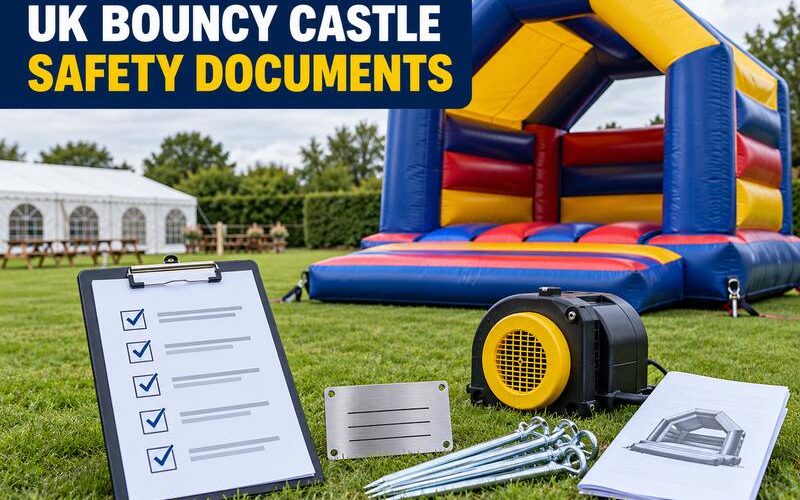
When buying a commercial bouncy castle for a UK hire business, price, size and design are only part of the decision.
You should also check what product information and safety documentation are available for the exact inflatable you intend to purchase. These documents can help you understand how the unit should be installed, operated, inspected and maintained.
They may also be requested by an inspector, insurer, venue, local authority or event organiser.
However, buyers can easily become confused by terms such as BS EN 14960, PIPA, RPII, initial inspection and annual inspection. These terms are related, but they do not all mean the same thing.
This guide explains the main documents and records UK commercial inflatable buyers should check before ordering.
1. Product Specification Sheet
Start with a clear specification sheet for the exact product model.
It should normally identify key details such as:
- Product name
- Model number
- Overall dimensions
- Internal play area
- Product height
- Approximate packed dimensions
- Approximate packed weight
- Recommended blower
- Number of inflation tubes
- Number of anchorage points
- Intended user group
- Manufacturer’s details
Do not rely only on photographs or a brief online description. Two inflatables that look similar may have different dimensions, weights, blower requirements or intended uses.
The model number shown on the specification sheet should match the product you are ordering.
2. Information About BS EN 14960
For many common bouncy castles and inflatable play products in the UK, the relevant standard is BS EN 14960-1:2019. It covers important areas such as design, manufacture, materials, structural integrity, anchorage, containment and testing.
Buyers should ask what information is available regarding the product’s design and manufacture in relation to the applicable parts of BS EN 14960.
However, an important point is often missed: BS EN 14960 does not cover every type of inflatable product.
Some interactive games, sealed inflatables, water-based products and specialist amusement devices may fall outside its scope or require a different assessment. Buyers should therefore avoid assuming that one standard automatically applies to every inflatable in a supplier’s catalogue.
Ask the manufacturer or a competent UK inspector to confirm which standard or inspection route is relevant to the particular product.
3. Initial Inspection Report
A new commercial inflatable should undergo an appropriate initial inspection before it enters service.
The purpose of the initial inspection is to check whether the product has been manufactured safely and whether it meets the relevant design and inspection requirements.
Depending on the product and inspection route, the assessment may examine:
- Dimensions and layout
- Containment walls
- Openings and entrances
- Anchorage points
- Blower compatibility
- Inflation pressure
- Stitching and seams
- Materials
- Sharp edges or entrapment risks
- Warning labels
- Manufacturer identification
- Operating information
Do not confuse a general material test report with an initial inspection of a finished inflatable. A PVC test report may provide useful information about the material, but it does not confirm that the entire completed product has been inspected.
When ordering, ask whether the finished unit will have an initial inspection report and who will conduct the inspection.
4. Annual Inspection Record
Commercial inflatable play equipment should be inspected at appropriate intervals by a competent person. In the UK inflatable hire industry, an annual inspection is the established approach for equipment covered by the relevant guidance.
An annual inspection is different from a daily or pre-use check.
Its purpose is to assess whether the inflatable remains safe after continued use, transport, cleaning, storage and repair. The inspector may review the condition of:
- Fabric
- Seams and stitching
- Internal structures
- Anchorage points
- Entrance and exit areas
- Containment walls
- Blower connections
- Pressure
- Labels
- Previous repairs
- Safety-critical accessories
A new inflatable’s initial documentation does not remove the need for future annual inspections.
The owner or operator should retain inspection reports and arrange the next inspection before the previous one expires.
5. PIPA Information
PIPA is a UK inspection scheme for inflatable play equipment.
Inflatables within the scope of the PIPA scheme may receive a PIPA tag and have their inspection information recorded within the scheme. This can help customers, venues and operators check the inspection status of the unit.
However, buyers should understand several important points:
- PIPA is an inspection scheme, not the name of the safety standard.
- A PIPA tag does not replace correct installation or daily checks.
- Not every type of inflatable falls within the scope of the PIPA scheme.
- Equipment outside the scheme may require another suitable inspection route.
- The inspection must relate to the individual inflatable, not simply to the manufacturer’s general product range.
If having a PIPA-tagged inflatable is important to your business, speak to a competent PIPA inspector before placing the order. The inspector can advise whether the chosen product falls within the scheme and what information will be required.
6. RPII Inspector Information
RPII stands for the Register of Play Inspectors International.
RPII examines and registers inspectors who have demonstrated the required competence for particular types of play equipment, including inflatable play equipment.
RPII and PIPA should not be treated as interchangeable terms. PIPA operates an inflatable inspection scheme, while RPII is associated with the examination, accreditation and registration of inspectors.
Before arranging an inspection, confirm that the person is currently qualified for the type of inflatable inspection required.
A general playground inspector is not automatically qualified to perform an annual inspection of inflatable play equipment.
7. Operating Manual
Every commercial inflatable should be supplied with clear operating information for the particular model.
The operating manual should explain matters such as:
- Intended use
- User restrictions
- Setup procedure
- Blower installation
- Anchorage
- Safe operating conditions
- Supervision
- Pre-use checks
- Deflation procedure
- Cleaning
- Storage
- Maintenance
- Emergency action
The instructions should match the actual inflatable. A very general manual covering every product in a catalogue may not provide enough model-specific information.
Operators should read the manual before using the inflatable and make the relevant information available to staff.
8. Anchorage Information
Correct anchorage is essential for the safe operation of a bouncy castle.
The documentation should identify:
- The number of anchorage points
- The position of the anchorage points
- How each point should be used
- Suitable anchoring methods
- Any restrictions relating to ground conditions
- What to do when ground stakes cannot be used
Do not assume that a few stakes supplied with the inflatable are enough information on their own.
The operator must understand how the inflatable should be anchored at each setup location. Alternative anchoring arrangements may need to be assessed where the inflatable is installed on a hard surface.
9. Blower Information
The blower is part of the operating system and should be suitable for the inflatable.
Check the following information:
- Blower model
- Voltage and frequency
- Power rating
- Plug type
- Number of blowers required
- Connection method
- Electrical identification
- Manufacturer’s instructions
For the UK market, buyers should confirm that the blower and plug arrangement are appropriate for the intended location and power supply.
The inflatable and blower should be clearly identifiable in inspection and maintenance records. A replacement blower should not be selected only because it fits the inflation tube.
10. Product Label and Serial Number
The inflatable should have a durable identification label or plate containing relevant product details.
Depending on the product, this may include:
- Manufacturer’s name
- Product name or unit type
- Model number
- Serial number
- Date or year of manufacture
- Blower information
- User information
- Relevant warnings
The serial number is particularly useful because it connects the physical inflatable to its inspection, maintenance and repair records.
Check that the serial number shown on the unit matches the number used in the corresponding documentation.
11. Pre-Use Inspection Checklist
An annual inspection does not confirm that the inflatable is safe on every day of operation.
The operator should complete a pre-use inspection before the equipment is made available to customers. A checklist can help staff examine areas such as:
- Fabric condition
- Seams
- Anchorage
- Blower operation
- Inflation pressure
- Electrical cables
- Entrance mats
- Surrounding space
- Weather conditions
- Access and supervision
- Visible damage
The results should be recorded according to the operator’s safety procedures.
If a safety-related defect is found, the inflatable should not be used until it has been properly assessed and repaired.
12. Maintenance and Repair Records
Commercial inflatables are repeatedly rolled, transported, installed and stored. Wear and damage can therefore develop over time.
Keep a record of:
- Cleaning
- Routine maintenance
- Damage
- Repairs
- Replacement parts
- Blower changes
- Inspection findings
- Corrective action
Safety-critical repairs should be completed using suitable materials and methods. If a repair could affect the design or safe operation of the inflatable, seek advice from the manufacturer or a competent inspector.
Good records help show the history of the unit and allow inspectors to identify recurring problems.
13. Risk Assessment and Emergency Procedures
A product certificate alone does not cover the way an inflatable is operated at a particular venue.
A hire business should assess the risks associated with delivery, setup, anchorage, electrical equipment, weather, supervision, users and emergency deflation.
Emergency procedures should explain what staff should do if:
- Weather conditions deteriorate
- The blower stops
- Power is lost
- An anchorage point becomes loose
- The inflatable is damaged
- A user is injured
- The unit begins to deflate unexpectedly
These procedures should be practical and understood by the people supervising the inflatable.
What Should You Ask the Manufacturer?
Before placing an order, send the manufacturer the exact model number and ask:
- What specification sheet is available?
- What standard applies to this product?
- Is an initial inspection report available?
- Is the product within the scope of BS EN 14960?
- Is it likely to fall within the PIPA scheme?
- What operating manual is supplied?
- Are anchorage and blower instructions included?
- Will the product have an individual serial number?
- What information will appear on the product label?
- Which documents relate to this exact unit?
Buyers should ask manufacturers, including suppliers such as East Inflatables UK, to confirm which documents are available for the exact product model rather than assuming that one general certificate covers every inflatable.
A manufacturer can supply product and manufacturing information, but the UK owner or operator remains responsible for arranging appropriate local inspections and operating the equipment safely.
Final Buyer’s Checklist
Before accepting a commercial inflatable, check that you have:
- A product specification sheet
- The correct model and serial number
- Information about the applicable standard
- An initial inspection report, where applicable
- Operating instructions
- Anchorage information
- Blower information
- Product identification details
- A pre-use inspection checklist
- Maintenance and repair records
- A plan for annual inspection
- Risk assessment and emergency procedures
Do not make a buying decision based only on price or appearance. Clear documentation makes it easier to inspect, operate and maintain the inflatable throughout its working life.
Frequently Asked Questions
Does Every UK Bouncy Castle Need a PIPA Tag?
Not every inflatable falls within the scope of the PIPA scheme. The correct inspection route depends on the product type and intended use. Ask a competent inspector whether the specific inflatable can be inspected and registered under the scheme.
Is PIPA the Same as BS EN 14960?
No. BS EN 14960 is a safety standard for specified types of inflatable play equipment. PIPA is an inspection scheme whose framework is based on relevant safety requirements and industry guidance.
Is RPII the Same as PIPA?
No. RPII examines and registers play inspectors, while PIPA operates an inspection scheme for inflatable play equipment. An inspector’s qualifications and the inspection scheme being used should be checked separately.
Does a New Bouncy Castle Need an Inspection?
New commercial inflatable equipment should have an appropriate initial inspection before entering service. The type of inspection and documentation required depends on the product and the applicable inspection route.
Is a Material Certificate Enough?
No. A material test report only provides information about the material tested. It does not confirm that the design and construction of the complete inflatable have been inspected.
How Often Should a Commercial Bouncy Castle Be Inspected?
Commercial inflatable play equipment should be inspected at appropriate intervals by a competent person. An annual inspection is the established industry approach for equipment covered by the relevant UK guidance. Pre-use checks are also required before operation.